Japan Examines AI-Powered Humanoid Robots for Defense
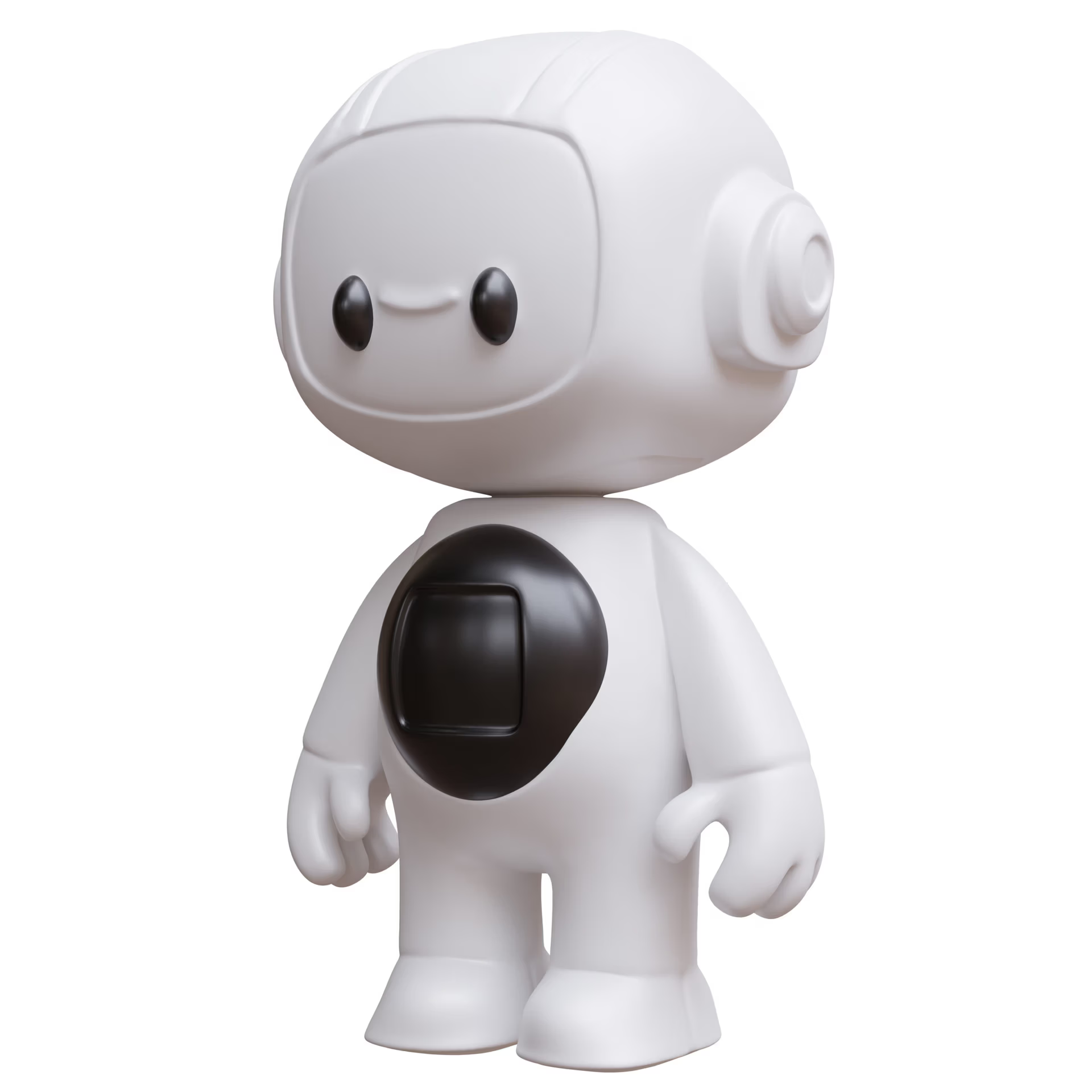
Japan is preparing to examine whether humanoid robots equipped with physical artificial intelligence could eventually be used to support the country’s defense operations, as the Self-Defense Forces face continuing difficulties in securing enough personnel.
Government and ruling party sources said the Japanese government plans to study the potential use of humanoid robots capable of operating in the physical world. The initial focus is expected to be on tasks that do not involve direct combat, with the technology potentially helping to reduce the workload placed on personnel and compensate for shortages within the Self-Defense Forces.
How Humanoid Robots Could Support Japan’s Defense Forces
One of the principal areas being considered is the use of humanoid robots for routine duties that currently require human personnel. Possible applications could include patrolling military facilities, transporting supplies and providing logistical assistance.
Robots could potentially operate in environments where sending personnel would be difficult, dangerous or inefficient. They could also eventually have applications in reconnaissance and rescue operations, depending on how the technology develops.
A humanoid design could provide particular advantages in environments built for people. Robots with arms, legs and a human-like body could potentially use existing stairs, doors, vehicles and equipment without requiring completely redesigned infrastructure.
For Japan, the technology is also relevant because of continuing difficulties surrounding recruitment and staffing within the Self-Defense Forces. Using autonomous or semi-autonomous machines for selected duties could allow human personnel to concentrate on responsibilities requiring specialist skills and decision-making.
What Physical AI Means
Physical AI differs from conventional software-based artificial intelligence because it combines AI systems with sensors, cameras and a physical machine capable of interacting with its surroundings.
A humanoid robot could use information gathered through cameras and other sensors to identify objects, understand its environment and perform assigned tasks. Advances in artificial intelligence are making it increasingly possible for machines to interpret changing surroundings rather than simply follow a fixed sequence of programmed movements.
Japan’s defense authorities have already identified AI and unmanned equipment as important areas for future development. Unmanned systems can potentially operate for extended periods in difficult environments without exposing personnel to the same risks.
The country is therefore examining unmanned technology across land, sea, underwater and air operations. Humanoid robots would represent a different category because they could potentially perform physical tasks normally associated with personnel rather than simply operating as remotely controlled vehicles or aircraft.
Testing Humanoid Robot Technology
As part of the planned study, Japanese authorities are expected to consider demonstrations or competitions involving humanoid robots developed by private companies and universities. Such trials would allow developers to demonstrate what their machines are capable of doing in realistic environments.
The emphasis would be on practical capabilities rather than simply producing a robot that resembles a human. A useful defense-support robot would need to navigate independently, recognise objects and obstacles, manipulate equipment and operate reliably for extended periods.
It would also need to function in environments where communications could be disrupted and where conditions may differ considerably from those used during laboratory testing. These factors could make real-world demonstrations particularly important before the technology could be considered for operational use.
Testing could give the government a clearer picture of how quickly humanoid technology is developing and which tasks might realistically be suitable for robotic assistance. It could also highlight technical limitations that are less obvious during controlled demonstrations.
Combat Applications Raise Different Questions
Despite the potential military applications, the immediate focus of the proposed study is not expected to be armed humanoid robots. There are significant concerns about allowing artificial intelligence to make decisions in situations involving the potential use of force.
An AI system could potentially misidentify people or objects, misunderstand changing circumstances or make an incorrect assessment based on incomplete information. These concerns become particularly important in environments where civilians and military personnel may be present at the same time.
Japan’s defense authorities have recognised that the development and use of AI creates technical, legal and operational issues. Reliability, cybersecurity, training data, accountability and the appropriate level of human involvement are among the questions that would have to be considered.
The distinction between support and combat is therefore significant. The immediate concept is focused on using machines to undertake selected supporting activities and reduce risks and workloads for personnel rather than replacing soldiers in combat.
Part of Japan’s Wider Defense Technology Strategy
The consideration of humanoid robots comes as Japan examines a much broader role for artificial intelligence in national defense. The government is also looking at the incorporation of domestically developed AI into Self-Defense Forces command and control systems.
The aim is to improve the speed and accuracy of information processing and decision-making while maintaining an appropriate level of human involvement. Japan is consequently examining AI across several different areas, ranging from command systems and intelligence analysis to unmanned vehicles and physical machines.
Humanoid robots remain an experimental area, however, and there is a substantial difference between demonstrating that a machine can complete a task and deploying it reliably within an operational defense environment. Cost, maintenance, cybersecurity, communications, battery life and autonomous operation would all need to be considered.
For now, Japan’s plan represents an investigation into what humanoid robots might eventually contribute to the Self-Defense Forces rather than a decision to deploy autonomous machines in combat. If the technology continues to advance, robots could potentially take on selected tasks involving logistics, facility patrols, reconnaissance or emergency assistance.
The planned research and demonstrations could provide an early indication of how Japan intends to balance the opportunities offered by physical AI with the technical, legal and operational challenges associated with increasingly autonomous machines. The immediate focus remains on developing technology that can support human personnel rather than replacing them.
Source: DePRESSeD Media Ltd