Gang of Angry Monkeys Surrounds and Attacks Man in Japan’s Hot Spring Town
A man in his 40s was attacked by a group of Japanese macaques in Yugawara, a popular hot spring town in Kanagawa Prefecture, after the animals surrounded him during an early-morning walk.
The incident is the latest in a growing series of problems involving a troop of wild monkeys that has increasingly moved into residential areas of the town. The animals have been blamed for threatening residents, entering properties and damaging gardens.
The man was reportedly walking near the entrance of a hotel at around 7 a.m. when approximately a dozen monkeys surrounded him. He was bitten several times on his hands and was taken to hospital for treatment.
Man Surrounded by Troop of Monkeys
The attack happened in Yugawara on September 17. The town is located in western Kanagawa Prefecture and is well known for its hot springs, traditional inns and mountainous surroundings.
The victim, who has not been publicly identified, was in his 40s when he encountered the monkeys. Rather than simply passing through the area, the animals surrounded him and attacked.
The monkeys bit his hands several times during the encounter. The injuries were serious enough for him to require treatment at a hospital, although reports did not indicate that his injuries were life-threatening.
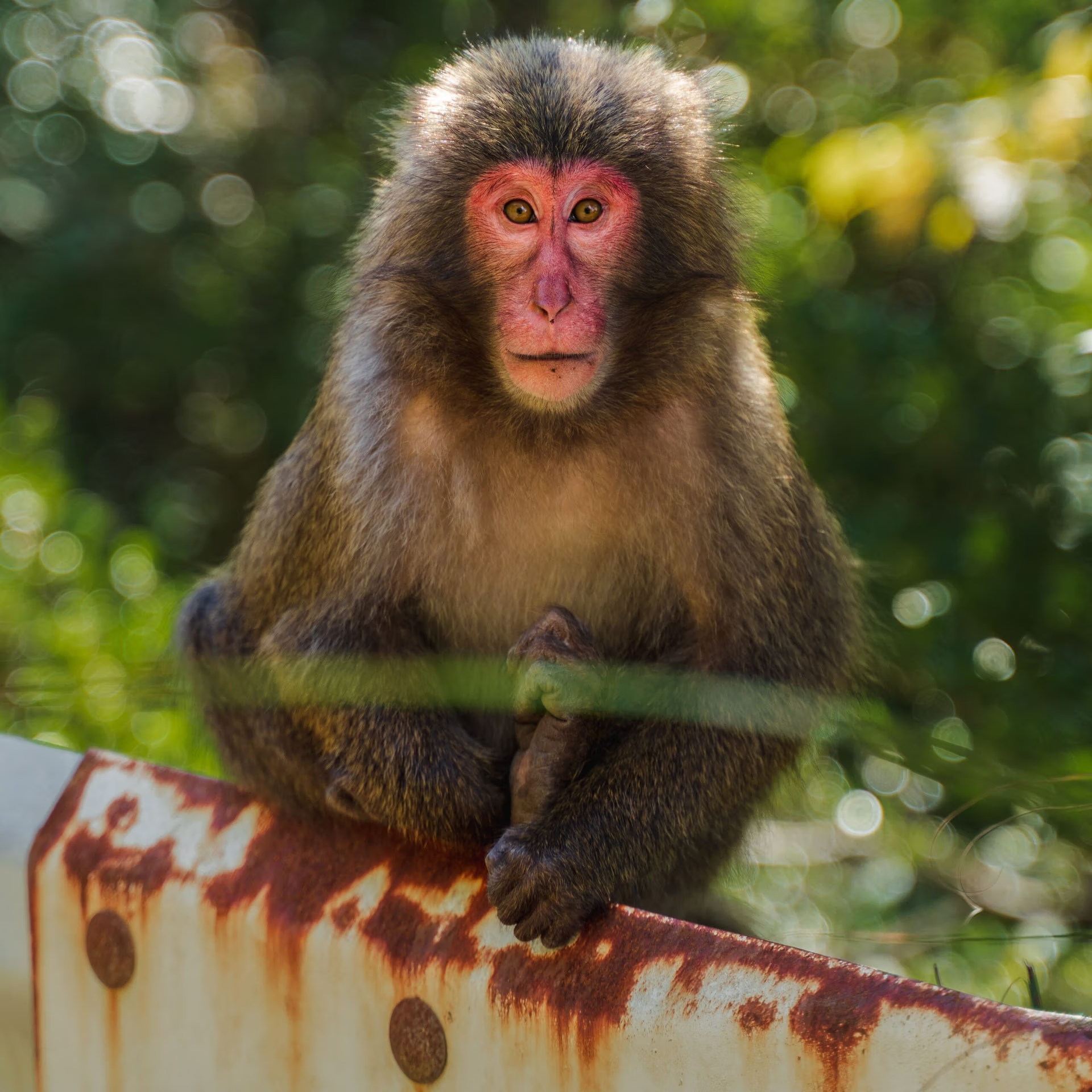
The animals are believed to belong to a troop known as T1, which has become a longstanding problem for people living in Yugawara. The troop has increasingly been seen away from the surrounding forests and in parts of the town where people live and work.
The latest attack has again highlighted the difficulty faced by residents of an area that is both a residential community and a popular destination for people visiting Japan for hot spring stays.
More Than 900 Aggressive Incidents Reported
The T1 troop has been associated with a large number of encounters involving people. More than 900 cases of monkeys behaving aggressively or threateningly towards humans were reported during 2025.
Those incidents have not been limited to people encountering monkeys in the countryside. The animals have increasingly appeared in built-up parts of Yugawara, including residential neighbourhoods.
Residents have reported monkeys entering gardens and homes, damaging vegetables and other plants, and creating problems around properties. Their increasing presence has changed everyday routines for some people living in affected parts of the town.
A previous investigation by Japan Forward reported that Yugawara recorded about 33,000 incidents involving monkeys over the four years through 2025. A household survey documented problems ranging from monkeys climbing onto roofs and making noise to damage to homes and threatening behaviour towards residents.
The survey recorded approximately 27,000 incidents between 2022 and 2024, followed by another 6,000 incidents in 2025. Many of the reported problems were concentrated around JR Yugawara Station and the area's hot spring district.
Monkeys Have Become Part of the Town’s Daily Problems
The presence of the monkeys has become more than an occasional wildlife encounter. Residents have described having to change normal activities because of the animals.
Some people have reported keeping their windows locked because monkeys use the surrounding area as a route. Others have stopped gardening after repeatedly encountering the animals near their homes.
There have also been reports of monkeys entering areas used by visitors. An open-air bath in the area was reportedly forced to close after monkeys began appearing nearby.
The situation is particularly significant because Yugawara's identity is closely connected to tourism. The town is known for its natural hot springs and traditional accommodation, attracting visitors looking for a quieter alternative to larger tourist destinations in the Tokyo region.
The increasing presence of wild macaques in the same areas used by residents and tourists therefore creates a difficult problem for local authorities. The monkeys are wild animals, but their habitat now overlaps with parts of the town used regularly by people.
The T1 Troop Has a Complicated Status
The monkeys are Japanese macaques, a native species that is found across large parts of Japan. The T1 troop is particularly significant because it is the last remaining troop in the Seisho area along the western coast of Sagami Bay.
A population survey conducted in 2025 confirmed 20 monkeys in the T1 troop. The animals' status makes the authorities' response more complicated than simply removing a nuisance population.
The regional population of Japanese macaques is listed by Kanagawa Prefecture as a population at risk of extinction. As a result, the authorities have to consider both the damage caused by the monkeys and the conservation status of the animals.
Kanagawa has previously taken action against other troops under its Japanese macaque management programme. Entire troops have been removed from some areas when their presence created serious problems for local communities.
The T1 troop, however, is the final remaining troop in the Seisho area, meaning that any decision to remove it entirely has wider implications for the regional macaque population.
Authorities Have Been Seeking Permission to Act
Yugawara's local authorities have been seeking permission from Kanagawa Prefecture to capture the T1 troop because of the continuing problems it causes for residents.
The request has been under consideration rather than being an immediate authorisation to remove the animals. The prefectural government has been examining how the monkeys should be managed as it prepares its next Japanese Macaque Management Plan.
That plan is scheduled to take effect in fiscal 2027. The question of what should happen to the T1 troop is therefore being considered as part of a wider approach to managing Japanese macaques across the prefecture.
The situation demonstrates why dealing with wildlife in populated areas can be complicated. Capturing or removing animals can reduce immediate risks to residents, but conservation rules and the status of the regional population also have to be taken into account.
Why Are the Monkeys Becoming More Aggressive?
The precise reason for the increasingly aggressive behaviour of the monkeys in Yugawara has not been established. Authorities have not identified a single cause that explains why the animals have become such a persistent presence in the town.
One issue raised in discussions about the problem is the availability of food. Japanese macaques can become accustomed to human environments when food is readily available, particularly if people feed them directly or leave food accessible.
A Primatological Society of Japan representative has suggested that feeding by tourists could contribute to the animals becoming accustomed to people and searching for food around human settlements.
However, the reasons for the behaviour of the particular T1 troop are not fully established. The animals' movement into residential areas is part of a broader wildlife-management issue involving the relationship between wild macaques and communities in Japan.
Japanese macaques are highly adaptable animals, and their ability to move between wooded areas and human settlements can make encounters difficult to prevent once a troop becomes accustomed to an urban environment.
Yugawara Has Long Had a Monkey Problem
The current situation is not entirely new. Agricultural damage caused by Japanese macaques in the wider Seisho area has been recorded for decades, including damage to mandarin orange crops dating back to the 1960s.
By the 1970s, monkeys were increasingly appearing in urban areas and causing injuries to people. The long history of the problem eventually contributed to the development of formal wildlife-management policies.
Kanagawa Prefecture introduced a management plan covering Japanese macaques across the prefecture in 2003. Its aim was to reduce damage caused by the animals while also maintaining regional macaque populations.
That balance remains particularly difficult in Yugawara because the T1 troop is both a source of significant disruption and part of a regional population that has conservation concerns.
Residents and Tourists Warned Not to Feed the Monkeys
Local authorities have urged residents and visitors not to feed the monkeys or provoke them. People are also being advised to contact police if they see a group of monkeys in the town.
The advice reflects the risks associated with approaching wild animals that have become accustomed to human environments. Feeding can encourage monkeys to associate people with food, while attempts to chase, confront or provoke them can increase the likelihood of an aggressive encounter.
For visitors to Yugawara, the warnings are particularly relevant because the town's hot spring areas are located close to the places where the monkeys have increasingly been seen.
Tourists visiting the town for its hot springs may expect to encounter Japan's wildlife while travelling through mountainous areas, but the T1 troop's presence in populated parts of Yugawara means that encounters can also occur close to hotels, homes and other buildings.
A Wildlife Problem in a Popular Tourist Destination
The latest attack illustrates the unusual situation now facing Yugawara. The town is known for relaxation, hot springs and traditional Japanese hospitality, yet some residents are dealing with wild monkeys moving through the same streets and neighbourhoods.
The attack on the man in his 40s adds another reported injury to a much larger record of encounters between people and the T1 troop. More than 900 aggressive or threatening incidents were reported during 2025, while wider surveys have documented thousands of monkey-related disruptions.
At the same time, the authorities cannot treat the issue solely as a public nuisance because the T1 troop forms part of a regional macaque population with conservation concerns.
Kanagawa Prefecture is therefore considering how the animals should be managed while Yugawara continues to seek measures that can protect residents and visitors. Until a long-term decision is made, people in the affected areas are being advised to avoid feeding or provoking the monkeys and to report sightings.
For the residents of Yugawara, the challenge is finding a way for a wild macaque population and a growing human community to coexist without further attacks. The latest incident shows that the problem is no longer an occasional encounter with wildlife, but an issue that has become part of everyday life in one of Japan's best-known hot spring towns.